2026: Q2 Returns
The first quarter of 2026 reminded us how quickly markets can change for the worse. The second quarter did too in a good way.
Broader markets started the year strong but then geopolitical chaos spilled into markets in March pushing most global indexes lower. Broader indexes closed the first quarter flat to a small loss.
The recovery was unexpectedly swift with almost all global markets higher in April and May. Broader markets finished the second quarter positive.
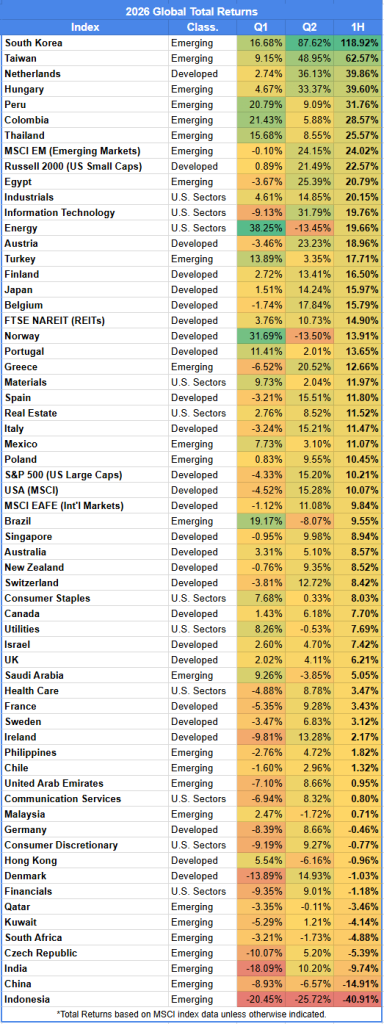
Emerging markets lead through Q2 with a 24.0% total return. Small caps follow closely behind at 22.6%. US large caps more than recovered at 10.2%, followed by international markets at 9.8%.
Overall, a diversified portfolio came in handy this year. It helped stem the slide in March and took advantage of the quick recovery. It also benefited from some craziness in emerging markets too.
Parabolic moves are rare in market indexes. Unless that index is concentrated in a small number of stocks. For example, the MSCI South Korea index, part of the MSCI Emerging Markets index, is made up of 77 stocks. Not a small number, by any means. Yet, look at its recent performance.
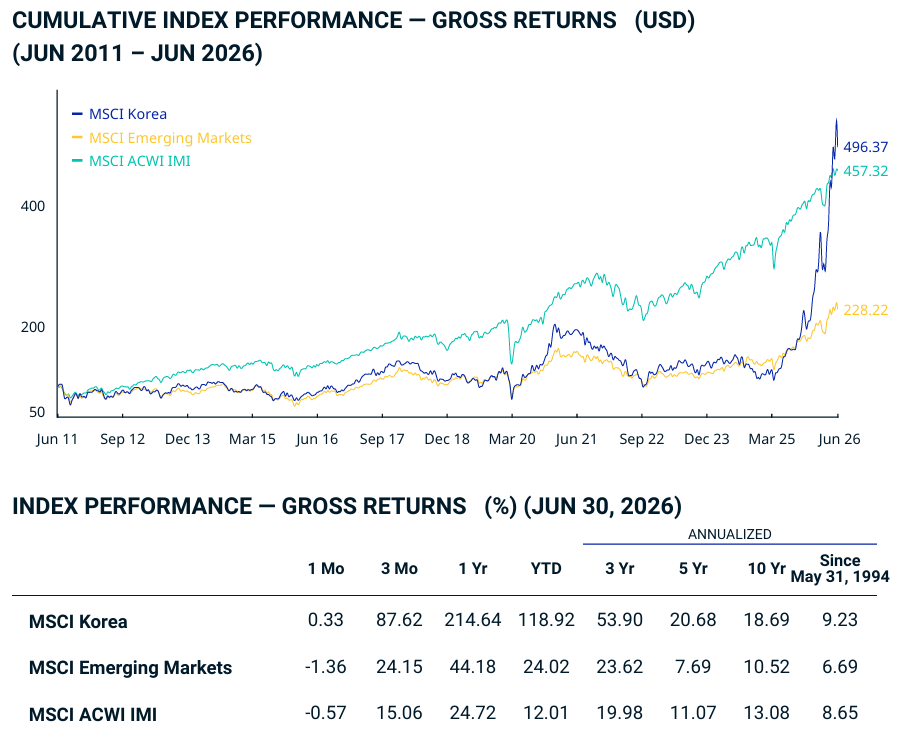
The MSCI Korea index has gone parabolic in the last year. The returns are phenomenal — 119% year to date. The last quarter alone it was up 87%!
What’s driving the South Korean index? Semiconductor stocks. The chart below compares the MSCI Korea index against the MSCI Korea Semiconductors index.
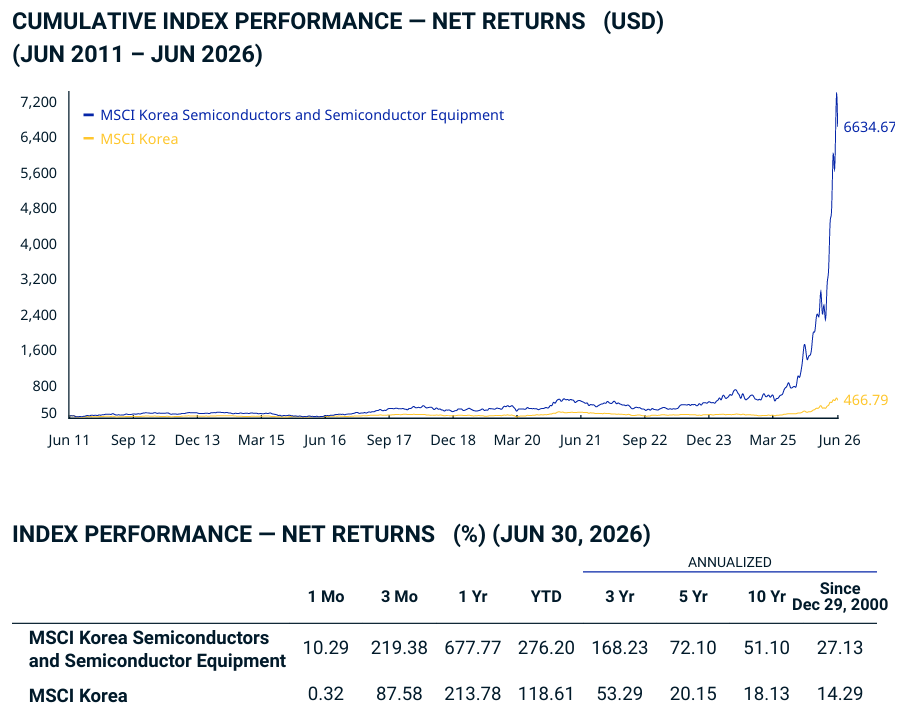
Semiconductor stocks have also gone parabolic in the last year. It makes the move in the MSCI Korea index seem tame.
Interestingly, the MSCI Korea Semiconductor index is made up of two stocks. One stock accounts for 99.3% of the overall index. That same stock has the second largest weighting in the MSCI Korea index at 32.2%.
The bulk of the South Korea index’s return, this year, is tied to two stocks that made up 67% of the overall index at the end of June. As those stocks go, so goes the index. Therein lies the risk.
Parabolic moves, like those in the charts, rarely end well. Speculation and leverage explain most it.
Borrowing to buy stocks come with risk. You may get wonderful returns on the way up, until the market turns — and it always turns — then it’s devastating.
If you’ve been lucky enough to enjoy the ride in semiconductors or a South Korea ETF, you should have a plan for selling down the position that doesn’t involving timing luck.
These parabolic moves are a lesson in how concentrated these smaller markets can be and why diversification is so important. You benefit from crazy market moves while spreading the risk that comes with concentration.
A quick note before the quarter highlights: The asset class, sector, international, and emerging market returns are up to date through June 30, 2026. Hit the links for each.
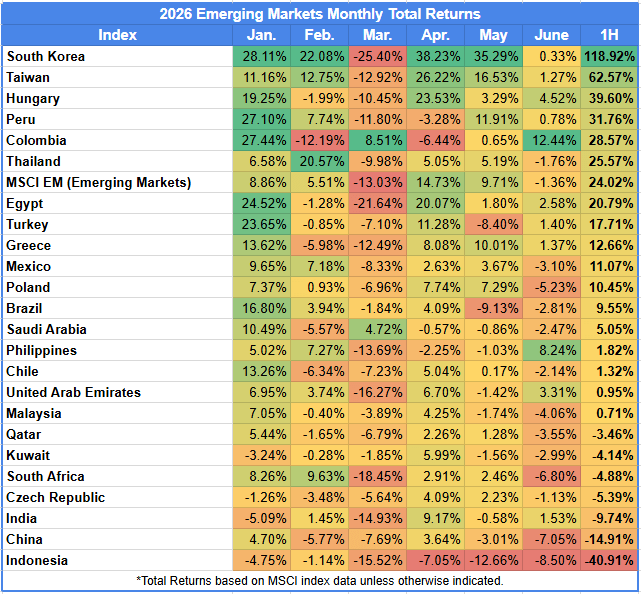
You’ll find four tables below. The US sector, developed markets, and emerging markets performance broken down by month. The last table shows quarterly returns for all three so far in 2026.
A few highlights stand out:
- All broader markets closed Q2 positive. Only one broader market, MSCI EAFE (international markets) fell short of its February close. The S&P 500, Russell 2000, REITs, and MSCI Emerging Markets are higher than they were before the chaos hit in March.
- US Industrials might be the best performing sector in the first half of the year, but Info Tech was the best performer in Q2. Technology stocks earned a 31.8% total return over the last three months.
- Only two US sectors fell in Q2. Energy fell 13.5% and Utilities dropped 0.5%. Both are still positive year to date.
- Small caps lead US equity asset classes on the year at 22.6% total return. 21.5% came in Q2.
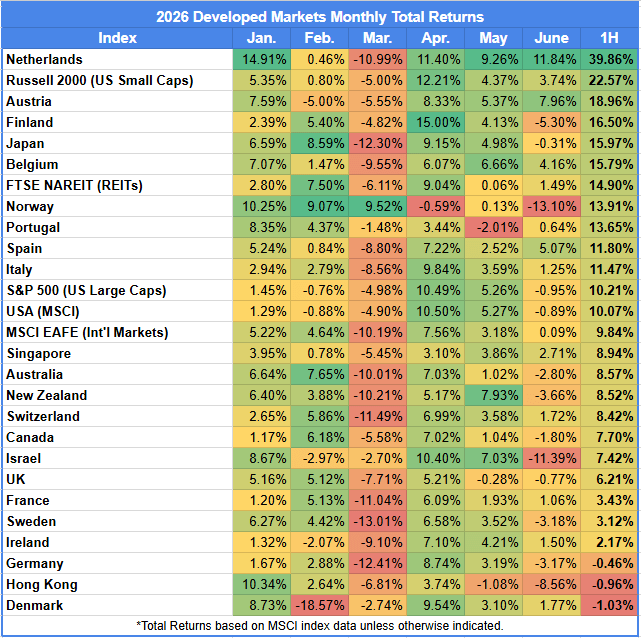
- Netherlands was the best performing developed market index through the first half of the year at 39.9%.
- Only two developed markets sit at a loss year to date…barely. The worst, Denmark, at -1% on the year.
- South Korea is the best performing (emerging and global) market this year. It’s 118.9% total return year to date exceeds its 2025 total return of 100.8%.
- Since the end of 2024, the South Korean index is up 339.5% total return.
- The three largest stocks in the MSCI Emerging Markets index are semiconductor stocks, two are also in the MSCI Korea index, with a weighting of 31% of the overall index at the end of June.
- Indonesia has seven months of consecutive losses going back to December 2025 and is the worst performer year to date. It’s on track for three losing years in a row. This year is, by far, the worst of the three.
- There have been 22 instances of 3 consecutive losing years in the history of MSCI’s emerging market indexes by country. Only one instance exists of 4 consecutive losses.

Sources:
Related Reading:
- 2026: Q1 Returns
- 2025: A Year in Returns