Are Stocks Going Up or Is the Dollar Going Down?
As stocks have hit new all-time highs in recent months, I’ve seen an increasing number of people argue that stocks aren’t becoming more valuable, the dollar is becoming less valuable. Investor Lee Roach articulated this “debasement theory” in a recent Twitter/X post:
The federal government is running a 7% structural deficit with no political coalition in either party willing to address it. The Treasury is issuing debt at a pace that will push publicly held debt-to-GDP past 130% within five years, which is the level at which, historically, every government in recorded history has either inflated its way out, defaulted, or both.
The Fed is, regardless of what it says in public, the marginal buyer of that debt, and the only mechanism it has to fund the purchases is the creation of new dollars. The money is being printed. The debt is being monetized. The currency is being debased. And asset prices, which are denominated in the currency being debased, are doing the only thing they have ever done in any country that has ever tried this, which is going up…
The lesson is not that asset prices are going up because the businesses are getting better. The lesson is that asset prices are going up because the unit they are measured in is getting smaller, and any investor who positions short against this dynamic is betting against the will and capacity of a government to debase its own currency, which is the single most reliable bet you can lose in 4,000 years of recorded monetary history….
The only investors who will, in real terms, preserve and grow their wealth are the ones who understood, early, that the game is not about being right on valuation, it is about being on the right side of monetary debasement, and the right side has always been owning real assets, productive businesses, scarce commodities, and the one monetary metal that has functioned as money continuously for 5,000 years, while the people on the other side continue to insist this time is different. This time has never been different. The math is the math. The shorts will continue to lose. The owners will continue to win.
Despite a few factual errors (e.g., Japan, the U.K., and other countries have gone beyond 130% debt-to-GDP without hyperinflation or default), Roach makes some valid points.
For example, the U.S. government does have a spending problem that neither party can resolve. This is mostly due to large entitlement programs (like Social Security) that are extremely difficult to reform. For example, even if we uncapped the payroll tax (to apply above $184,500 in income for 2026 and beyond), about one-third of the funding shortfall for Social Security would remain. Why campaign for something so politically unpopular when it won’t solve the problem anyways?
Additionally, Roach is right that, on a long enough timeline, inflation destroys a currency. And the best way to fight inflation is owning real, productive assets. Just Keep Buying, am I right?
But this is where my agreement with Roach (and “debasement theory” in general) ends. Because though governments historically have defaulted on their debts or hyperinflated their currencies, this doesn’t mean the U.S. has to.
There are two reasons for this. First, the U.S. controls the world’s reserve currency. No other government that experienced hyperinflation—not Weimar Germany, not Zimbabwe, not Argentina—can say the same thing. This matters because it creates constant demand for dollars that makes a stampede out of them (via hyperinflation) less likely. Ultimately, the U.S. has more power to borrow and print than any government that hyperinflated ever had.
Second, inflation is not the same as hyperinflation. What the U.S. is experiencing today looks nothing like the hyperinflation episodes Roach cites. From January 2020 to May 2026, U.S. CPI increased by 29%. Over the same time period, U.S. home prices increased by 55%.
Using those two estimates as a range, the U.S. dollar has lost anywhere from 22%-35% of its purchasing power over the last 6 years. That’s not great, but let’s compare it to an actual case of hyperinflation—Germany in the aftermath of WWI. As Adam Fergusson noted in When Money Dies:
The mark’s fall began gradually. In the war years, 1914-1918, its foreign exchange value halved, and by August 1919 it halved again. In early 1920, however, although the cost of living had risen less than nine times since 1914, the mark had one fortieth of its overseas purchasing power left.
Over 6 years the mark lost nearly 98% of its purchasing power! That’s what true currency debasement looks like, not a 22%-35% decline over a similar timeframe.
But what have U.S. stocks done over the last 6 years in comparison? Are they only up 29%-55% to match inflation as Roach suggests?
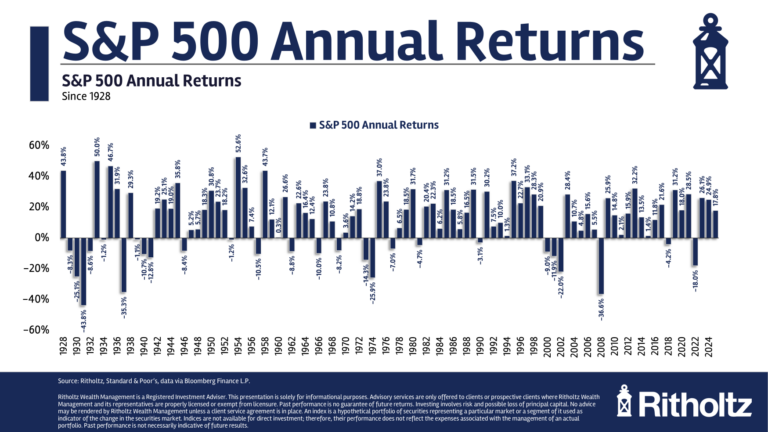
Not even close. The S&P 500 is up 143% (including reinvested dividends) from January 2020 to May 2026. When we include dividends and adjust for inflation, the S&P 500 is up 88% over this time period:

This means that every dollar invested in the S&P 500 in January 2020 has 88% more purchasing power today. That’s 88% more goods and services that you can buy in the post-COVID world than the pre-COVID one (had your money been fully invested in U.S. stocks).
Even if our measure of inflation is off slightly, the S&P 500 would have outpaced it since the beginning of 2020.
Why have U.S. stocks gone up so much? Mostly because of earnings growth. A few months ago Chart Kid Matt broke down how the driver of equity returns in 2026 has been earnings growth, not multiple expansion:

In fact, earnings growth more than made up for contracted multiples in the early part of 2026.
Does inflation influence earnings growth? Of course. As businesses raise prices, that additional revenue can make its way to the bottom line. But if this was all inflation, we would expect stock prices to closely follow changes in CPI over time, not greatly exceed them.
Does this mean that stocks are going up? Or is the dollar going down?
The answer is both. Throughout most of U.S. history the answer has been both as well.
The U.S. government has been devaluing the dollar since the Federal Reserve was created in 1913. That devaluation is slightly quicker today than it’s been for much of the past 40 years, but that’s it.
This is my problem with the debasement theory—the argument is directionally correct, but the speed is wrong. Inflation has sped up, but that doesn’t imply that hyperinflation is imminent.
Regardless of how quickly inflation proceeds from here, this discussion demonstrates why you should own income-producing assets. Because, ultimately, what other choice do you have?
The Solution That Works (Whether You Are Right or Wrong)
I’ve never understood the people who argue that the stock market is only going up because of the Fed’s money printing. It reminds me of this meme:

I don’t understand them because whether they are right or wrong, the solution is the same—buy assets and keep buying them. Ironically, Just Keep Buying is the perfect strategy to counteract currency debasement, whether it’s 2% (or 20%) per year.
This is why I don’t worry about hyperinflation or a melt-up. Because if either occurs, my portfolio is prepared for it. If you have a significant chunk of your wealth in productive, financial assets, you’re prepared for it too.
Whether stocks go up or the dollar goes down, the continual purchase of income-producing assets will always be your best bet.
Happy investing and thank you for reading.
If you liked this post, consider signing up for my newsletter.
This is post 511. Any code I have related to this post can be found here with the same numbering: