Top retail insurance brokers in the USA
Jump to winners | Jump to methodology
Why the top retail insurance brokers in the USA win in 2026
Insurance Business America reveals the Top Retail Insurance Brokers in the USA for 2026 – the specialists redefining commercial P&C broking
The top retail insurance brokers in the USA are not winning in 2026 by riding market conditions. They are winning despite them. The United States commercial insurance market entered 2026 in transition: a 33-quarter streak of premium increases ended in the first quarter of 2026, according to the Council of Insurance Agents and Brokers (CIAB), when average commercial premiums across all account sizes fell 1.2 percent – the clearest indicator yet that the hard market conditions of recent years are easing. For retail brokers, the question is straightforward: when the market stops doing the heavy lifting, what takes over?
The answer, according to the evidence of Insurance Business America’s 12th annual Top Retail Brokers list, is specialization. The 24 retail insurance professionals recognized in 2026 have all made the same fundamental choice: they went deep into a defined market – construction, real estate, healthcare, energy, hospitality, and professional liability – and built expertise that generalist competitors cannot replicate. In a softening rate environment where clients have more negotiating leverage and carrier capacity is expanding, that depth is the competitive moat.
IBA’s Top Retail Brokers list (formerly known as Top Producers) celebrates the highest-performing retail insurance professionals across the country. To be eligible for the 2026 list, nominees needed to generate at least $1 million in commission revenue in 2025, with a minimum of 50 percent coming from commercial property and casualty (P&C) business, and demonstrate year-over-year growth from 2024. Those reporting over $4 million in commission revenue earned the prestigious title of Platinum Retail Broker.


“A top retail insurance broker is not defined by premium volume or market access alone but by impact. A true top broker serves as a strategic partner, not just an intermediary between client and carrier”
Shantelle CabirNewfront
This report profiles the 2026 winners, examines what the best retail insurance brokers in the United States share, and explores how deep niche expertise, proactive risk advisory, technology adoption, and client retention discipline are shaping the next chapter of commercial insurance distribution in America.
The US commercial insurance landscape in 2026
The US insurance brokerage market is valued at $145.8 billion in 2026, projected to reach $176.14 billion by 2031 at a compound annual growth rate of 3.86 percent, according to Mordor Intelligence research published in January 2026. Retail brokers account for 60.55 percent of that market – the dominant channel through which commercial P&C business is placed. The structural position of the retail broker is secure. The economics, however, are shifting.
After several consecutive years of hard market conditions – rising rates, tightening capacity, and outsized organic revenue growth for brokers able to capture premium increases – the cycle is turning. According to Willis Towers Watson’s (WTW) Commercial Lines Insurance Pricing Survey (CLIPS), published March 11, 2026, US commercial insurance rates increased 2.9 percent in Q4 2025, the fourth consecutive quarter of deceleration: 5.6 percent in Q4 2024, 5.3 percent in Q1 2025, 3.8 percent in both Q2 and Q3 2025, and 2.9 percent in Q4 2025. The CIAB Q1 2026 survey confirmed the shift: average premiums fell 1.2 percent overall, with large commercial accounts declining 2.7 percent and medium accounts declining 1.9 percent.
The market is not softening uniformly, however. According to USI Insurance Services’ 2026 P&C Market Outlook, the landscape presents a study in contrasts. Property rates have turned meaningfully negative, with commercial property premiums declining approximately 4 percent on the back of abundant reinsurance capital and a quieter-than-expected 2025 hurricane season. Commercial auto, by contrast, remains under pressure: according to the CIAB Q1 2026 Commercial P&C Market Index, commercial auto premiums increased 5.8 percent in Q1 2026 – the 59th consecutive quarter of increases for that line, driven by nuclear verdicts, social inflation, rising repair costs, and deteriorating loss ratios. AM Best has characterized commercial auto as one of the worst-performing P&C segments over the last decade, with the line posting underwriting losses exceeding $5 billion in both 2023 and 2024.
Social inflation is the defining force behind the hardening casualty lines. The Swiss Re Institute reported that annual employment practices liability claim costs grew approximately 7 percent in 2024 – the highest annual increase in two decades, as cited in the USI Insurance Services 2026 P&C Market Outlook. For the best retail insurance brokers in America serving construction, real estate, and habitational sectors, navigating that split market – capturing property savings while managing deteriorating casualty terms – is where genuine advisory value is demonstrated.
Consolidation is the third structural force reshaping the landscape. Insurance distribution mergers and acquisitions (M&A) activity remains robust in 2026, with major players including Arthur J. Gallagher & Co. (AJG), Brown & Brown, Aon, and Marsh continuing to lead dealmaking, according to PwC. Several winners on the 2026 list operate within large national platforms – Acrisure, Lockton, Gallagher, Higginbotham, and Newfront – which provide capital, technology, and carrier relationships that independent operators must work harder to replicate. According to MarshBerry’s proprietary financial management system Perspectives for High Performance, specialist brokers grow at a faster pace than generalists – a finding the firm cites as evidence of a broader industry shift toward vertical specialization.
“Retail brokers who have both a strategy and governance mechanisms in place across each of these carriers are best positioned to capture share and perform well over the next two years,” says Matthew Scally, partner at McKinsey. “Those who have clear visibility into their book retention metrics across lines of business and geographies and can point to clear renewal and client servicing playbooks that account teams and producers are following are showing stronger retention numbers.”
Top retail insurance brokers in the USA 2026 – by the numbers
IBA received nominations from across the country before arriving at the 2026 winner cohort. The data reveals a clear demographic and operational profile of the elite retail insurance professional in the United States today.
Geography of the 2026 top retail insurance brokers in the USA
Florida leads the 2026 cohort with five winners – approximately 22 percent of the total – reflecting both the state’s complex risk environment and its concentration of specialist brokers serving real estate, condominium associations, and hospitality sectors. Louisiana produced three winners (12 percent), while California and Texas each contributed two. The remaining 12 winners are spread across Georgia, Illinois, Iowa, Kentucky, Maryland, Mississippi, New Jersey, New York, Pennsylvania, Vermont, Virginia, Wyoming, and Arizona. The geographic spread confirms that elite performance in retail insurance broking in the United States is not concentrated in traditional financial centers.
Experience and tenure of leading retail insurance brokers
Half of the 2026 top retail insurance brokers in the USA have between 11 and 20 years of industry experience. Twenty-seven percent have 21–30 years of experience, and 18 percent have more than 30 years of experience. Only one winner falls in the six- to 10-year category. The experience profile is significant: elite retail insurance broking in America compounds over time. Relationships, carrier credibility, and niche expertise are built across decades, not quarters.
Revenue and the Platinum tier
The Platinum Retail Broker designation – awarded to those reporting over $4 million in commission revenue in 2025 – covers approximately 12 winners in the 2026 cohort. Revenue across all 2026 winners runs from $950,000 to $44,946,825.
Where leading US retail insurance brokers operate
Fifty percent of the 2026 winners describe their business reach as regional – a counterintuitive finding for a list of the top commercial insurance brokers in the United States. Regional depth, it turns out, is not a limitation for the highest earners; it is a deliberate strategy. Twenty-seven percent operate multinationally, and 18 percent operate nationally across all 50 states, with just one winner operating locally.
How top retail insurance brokers in the USA are winning in 2026
The 2026 winners were asked directly: What does a top retail insurance broker look like? Their collective answers – across many niches, geographies, and firm structures – converge on a coherent picture.
Insurance Business America
Top Retail Brokers 2026 — Cohort analysis
Data profile of the 2026 IBA Top Retail Brokers cohort — 24 winners across 14 US states, drawn from broker submissions, revenue data, and self-reported specializations.
Winners
24
Across 14 US states, 12th annual list
Platinum brokers
12
Over $4M commission revenue in 2025
Highest revenue
$44.9M
2025 commission — Fred Zutel, Lockton FL
Top growth
+107%
Highest single year-on-year revenue gain
Geographic reach of practice
Top revenue growth — 2024 to 2025
Brian GilbergAcrisure — Pennsylvania
Fernando SilvaLockton — Florida
Adam GablerNewfront — Wyoming
Gary TaffetAcrisure — New Jersey
Jason MorrisMorris Insurance Group — Louisiana
“A top retail broker is not defined by premium volume or market access alone, but by impact. A true top broker serves as a strategic partner, not just an intermediary between client and carrier.”
Shantelle Cabir, SVP / Business Insurance Broker, Newfront — California | IBA Top Retail Broker 2026
Niche specialization
Every winner operates in a defined risk class — construction, real estate, healthcare, energy, hospitality or professional liability. None are generalists.
Strategic advisory
Winners describe their role as equivalent to a lawyer or CPA — proactive year-round advisors, not renewal-season policy vendors.
Retention-first mindset
Client retention is the primary performance metric. Multiple winners explicitly prioritize existing clients over new business development.
Technology as multiplier
AI tools, contract review platforms and automation free time for strategic work — but do not substitute for human advisory relationships.
AM Best standards
Near-universal minimum of AM Best A- for carrier partners. Carrier financial stability is treated as a non-negotiable client protection, not a preference.
Service infrastructure
Top performers have specialist support structures — dedicated staff per line, defined response-time targets, and systems for managing high client volumes.
Insurance Business America
Top Retail Brokers 2026 — Anatomy of a top performer
Six interconnected disciplines that define elite retail broking performance — drawn from IBA Top Retail Brokers 2026 winner submissions. Click any element to explore.
Click any spoke to expand detail below
Select a spoke to explore
Click any of the six disciplines above to see the detail behind what separates America’s top retail brokers from the rest of the field.
Niche specialization: the defining trait of top retail insurance agents in the USA
Across virtually every submission, the top retail insurance brokers in the USA reject the generalist model. They have staked out a specific risk class and built genuine expertise in it. The 2026 cohort covers construction and surety, multi-family real estate, medical professional liability, energy and oil and gas, hospitality, professional liability and cyber, condominium associations, performing arts, and M&A transaction insurance.
This is not a marketing choice. According to MarshBerry’s proprietary benchmarking data, specialist brokers grow faster than generalists – a finding reflected directly in the revenue trajectories on the 2026 list. A broker who specializes in construction risk brings underwriting credibility, contractual knowledge, and carrier relationships that a generalist cannot replicate at short notice. In a softening market where clients have more options, that irreplaceability is what protects a book of business.
“Clients want a broker who wakes up every day with their focus on their industry. You can’t wake up on a Monday writing a construction risk and Tuesday working through a medical professional liability program for a hospital,” says Lee Newmark, senior director, healthcare practice at Gallagher and one of IBA’s Top Retail Brokers 2026.
Strategic advisory: the best retail insurance brokers in America lead with value, not price
The 2026 winners consistently describe their role as that of a trusted advisor – comparable in function to a lawyer or accountant – rather than a policy intermediary. They engage with clients proactively throughout the year, not only at renewal. They review policies for coverage gaps. They model the total cost of risk, not just the premium. They help clients understand how business growth creates new insurance exposures and how to manage those exposures rather than simply transferring them.
This advisory posture drives the referral volumes and multi-year retention rates that define the highest earners on this list. It also reflects the broader direction of the profession: as AI and digital platforms make transactional insurance placement increasingly commoditized, the brokers who have already made the transition to genuine risk advisory are best positioned for the next decade.
Technology: how leading US retail insurance brokers use AI
The 2026 cohort does not reject technology – they deploy it deliberately. According to Gallagher’s 2026 AI Adoption and Risk Survey of more than 1,200 organizations worldwide, 63 percent of businesses had fully operationalized or implemented AI by February 2026, up from 45 percent in 2025 – an 18-point increase in 12 months. Grant Thornton’s 2026 AI Impact Survey of 100 insurance industry executives found that 52 percent report direct revenue growth from AI investments, 15 points above the cross-industry average.
Scally cites a recent survey of brokers showing only 10–15% are reporting seeing any kind of impact from AI today. “That said, the retail brokerage model is well positioned today to utilize AI effectively to improve accuracy and efficiency in their day-to-day servicing, drive growth, and even provide an extension of core services to their clients through loss and risk mitigation enhancements with AI,” he says. “The brokers who have built an AI strategy, a clear roadmap to focus on use cases for efficiency gain and relieving client pain points, are ahead of the curve, especially if they have an approved governance model in place.”
The top retail insurance brokers in the USA are navigating this shift with a clear philosophy: technology handles administrative load, freeing time for the high-value advisory work that clients need. AI-powered contract review tools, workflow automation, and client analytics platforms are mentioned across multiple submissions. The critical distinction these winners make is that technology serves the relationship – it does not substitute for it.
Client retention: the primary metric of elite retail insurance brokers in the USA
Multiple winners explicitly identify client retention – not new business acquisition – as their primary performance metric. The logic is structural: a high-retention book compounds in value year after year as clients expand, deepen coverage, and refer peers. Several winners note that their longest-standing clients started with modest programs and have grown to complex, high-value accounts as their businesses scaled.
Carrier standards: AM Best ratings as a non-negotiable floor
Almost universally, the 2026 top retail insurance brokers in the USA hold firm on AM Best minimum ratings for carrier partners. Most require an A- as an absolute floor, with many specifying A or A+. This standard reflects professional accountability to clients: placing business with financially unstable carriers is a reputational and liability risk that no top retail broker is willing to accept.
Winner profile: Shantelle Cabir, Newfront
Shantelle Cabir, senior vice president and business insurance broker at Newfront in California, is a 16-year veteran of the commercial insurance market and one of the top retail insurance brokers in the USA in 2026. Her 2025 commission revenue of $3.1 million – 10.7 percent growth over 2024 – is built on a disciplined specialist practice focused on blue-collar businesses in construction and agriculture.
Cabir’s approach begins with a policy review. She targets businesses that have grown significantly – from $1 or $2 million in annual sales to $20 million or more – without updating their coverage to reflect their expanded exposure. Finding and closing that gap is where she delivers her most distinctive value. She describes her role not as that of a policy vendor but as a strategic business partner: proactive year-round, consultative in approach, and transparent when markets are difficult.
Newfront, whose acquisition by WTW was completed on January 27, 2026 – now operating as part of WTW’s Risk & Broking segment – has been positioned at the forefront of insurance technology for six years. Cabir continues with the firm through the WTW integration, leveraging the platform’s AI contract review tool and enterprise workflow automation to free her team for advisory work. Her response to the commercial auto crisis in California – where carriers have struggled to achieve profitability and premium costs have risen significantly – is to lean into packaging strategies and underwriter relationships, consolidating client programs to create negotiating leverage.
“Client retention remains the top priority. I maintain high retention rates by prioritizing existing client needs over new business development”
Shantelle CabirNewfront
Q&A: Shantelle Cabir, Senior Vice President, Newfront
Q: What does it mean to be a top retail insurance broker in the USA in your view
A: A top retail insurance broker is not defined by premium volume or market access alone, but by impact. A true top broker serves as a strategic partner, not just an intermediary between client and carrier. That means deeply understanding a client’s operations, risk exposures, and long-term goals. It requires translating complex underwriting language, claims data, and market conditions into clear strategies that business owners can act on confidently. A top broker does not wait for renewal season to provide value. They are proactive year-round.
Q: What has been the biggest market challenge over the past year?
A: Clients are seeking creative solutions more than ever, particularly wanting to understand the “why” behind coverage recommendations. The biggest current challenge is commercial auto insurance cost increases, with unprecedented rates, especially in California. California carriers struggle to be profitable on auto insurance. Our team responds by partnering heavily with underwriters and finding packaging opportunities to create more favorable terms.
Q: How are you thinking about AI in your business?
A: Newfront has been at the forefront of AI and insurance technology for six years. We use an AI contract review tool that analyzes agreements and recommends changes, which has been a major selling point. We have integrated enterprise AI tools into operations to automate workflow tasks. The philosophy is to free people for strategic work rather than mundane tasks. Businesses must embrace AI to remain competitive – major brokers are investing millions to billions of dollars in AI development. But the human relationship element remains essential.
Q: How do you manage work-life balance at this level of production?
A: Balance does not mean equal distribution. Some days you allocate 40 percent to work, 20 percent to family, 40 percent to personal priorities – other days the split looks completely different. Pursuing constant equilibrium leads to feelings of failure. Mental stability is foundational. Managing pressure requires recognizing that most of it is self-imposed rather than external.
Winner profile: Joel Hirschfeld, Hirschfeld & Associates
Joel Hirschfeld, president of Hirschfeld & Associates in New York, has built a tightly defined specialist operation in the New York metropolitan market: a fully integrated brokerage purpose-built for mid-market real estate owners, property managers, and contractors who are frustrated by the fragmented model of dealing with separate brokers for personal lines, commercial liability, and umbrella coverage. His answer is a single firm that handles all of it – eliminating the coordination gaps that leave clients exposed and the administrative overhead that comes with managing multiple broker relationships.
His 2025 commission revenue of $6 million represents 15.4 percent growth over 2024, driven by a client base of 17,650 active accounts – the largest of any winner on the 2026 list – and 12,000 policies written in the year. That volume reflects the compounding effect of his model: when a client’s construction company grows, their property portfolio expands, and their personal net worth increases, Hirschfeld’s firm captures every layer of that growth without the client needing to repeat their story to a new broker. He operates across multiple states with 11–20 years of industry experience, with a commercial P&C concentration of 75 percent.
The 2025 operating year was defined by rapid growth and the challenge of managing it. Hirschfeld scaled his team and relocated to a new office three times the size of his previous space to accommodate demand. Intensive training for new staff was required to maintain the service standards – including 30-minute email response targets and 24-hour task completion – that his client base had come to expect. That he grew through it reflects both the durability of his client relationships and the operational systems he had built.
On the market side, Hirschfeld identifies lender requirements as the defining pressure point of 2025. Banks have become significantly more stringent in their property coverage demands, making it harder and more expensive to obtain policies that satisfy lender standards. This is precisely where his integrated model earns its value: because Hirschfeld holds all of a client’s lines simultaneously – commercial property, general liability, umbrella, personal – he can engineer packaging solutions and work multiple carrier options in parallel rather than in sequence. In a market where lender compliance and coverage adequacy must be resolved together, a broker who holds all the pieces has a structural advantage over a competitor managing only one.
“My biggest attribute is my dedication to building genuine, personalized relationships with my clients. We don’t just sell policies – we walk clients through each step, helping them feel supported and confident in their choices”
Joel HirschfeldHirschfeld & Associates
Q&A: Joel Hirschfeld, President, Hirschfeld & Associates
Q: What is the biggest attribute you bring to retail insurance broking day to day?
A: My biggest attribute is my dedication to building genuine, personalized relationships with my clients. Our approach is very tailored – we treat each customer as an individual, taking the time to understand their specific needs and circumstances. We don’t just sell policies; we walk clients through each step, helping them feel supported and confident in their choices. We leverage our expertise to help clients navigate claims, advocate for their rights when needed, and ensure they get the best possible outcome. Happy clients often start with smaller projects, and over time, they return with larger ones, refer family and friends, and become true advocates for my service and the firm.
Q: What was the biggest challenge over the past 12 months?
A: My biggest challenge was managing rapid growth without being fully prepared for it. We faced an overload of work and didn’t have enough staff to handle the increased demand. As a result, everyone had to put in overtime and work intensively within a packed schedule. To address this, we gradually hired new staff and relocated to a larger workspace. We provided intensive training for the new employees, enabling them to service clients effectively. These steps helped ease the pressure and allowed us to operate more efficiently.
Q: How do you define success professionally?
A: For me, success is all about my clients. When clients return for additional policies, larger projects, or new developments – and when they refer friends and colleagues – it shows I’ve earned their trust and satisfaction. Building long-term relationships and receiving ongoing referrals are the ultimate indicators that I am providing exceptional support and delivering value.
Q: What market trends are you seeing from clients?
A: We have noticed that banks are becoming much more stringent with their requests. Their requirements for properties are now very strict, making it challenging to obtain policies that meet their standards. We work on all fronts and explore all possible options to offer our clients the most affordable solutions without compromising on coverage, ensuring we satisfy their lender’s requirements as well.
Q: Where are you on AI in your broking practice?
A: Currently, we primarily use AI for minor tasks; however, we recognize its potential and are actively exploring new AI software to enhance efficiency. While AI can assist in processing information and handling routine tasks quickly, the core of my work – understanding clients’ needs, building relationships, and providing personalized advice – remains human-centric. AI can support our processes, but it cannot replace the personal touch that is vital in broking.
Q: How do you manage turnaround times and multiple client demands?
A: Customer service is my top priority. We have multiple secretaries, each dedicated to a specific line of business, so they can focus solely on their area and provide expert support. We respond to all emails within 30 minutes, and each task is targeted for completion within 24 hours. Balancing multiple demands requires strong organization, clear communication, and managing expectations upfront.
What comes next for retail insurance brokers in the USA
The next 12–24 months will test whether the specialist advantage holds in a genuinely softening market. The combination of easing property rates, expanding carrier capacity, and accelerating brokerage consolidation creates an environment where generalist brokers face margin compression while clients gain negotiating leverage. The best retail insurance brokers in America – those who have already built deep niche expertise and genuine advisory practices – are best placed to retain and grow their books through that pressure.
Technology will continue to be a separating factor. The top retail insurance brokers in the USA who are already deploying AI-powered tools – contract review, workflow automation, and client analytics – will compound those efficiency gains over the next two years while competitors are still building baseline infrastructure. According to Grant Thornton’s 2026 AI Impact Survey, 52 percent of insurance executives are already reporting AI-enabled revenue growth, but 44 percent report that governance or compliance challenges have contributed to AI project failure. The brokers who deploy technology with discipline – not just enthusiasm – will see the most durable returns.
Commercial auto will remain the most challenging line nationally, with California presenting the most acute profitability problem for carriers. Construction and real estate programs will see continued complexity as project volumes fluctuate with interest rate conditions and contractual risk transfer requirements become more sophisticated. For the leading commercial insurance brokers in the United States operating in these sectors, creative program design – consolidating coverage, leveraging carrier relationships, and delivering real claims advocacy – will be the differentiator.
The M&A landscape will continue to reshape the environment around individual retail brokers. Large national platforms will acquire smaller operations, and top producers will face recurring decisions about affiliation, independence, or leveraging a large firm’s infrastructure while retaining their specialist identity. The 2026 winners list includes brokers at every point on that spectrum – from boutique principals to senior vice presidents inside multibillion-dollar firms – confirming that no single structural path defines elite performance in retail insurance broking in the United States.
The 24 brokers recognized as the top retail insurance brokers in the USA for 2026 share one defining characteristic: they made a deliberate choice about who they serve and how. They are not trying to be all things to all clients. They chose a specific market, built deep expertise in it, and positioned themselves as trusted advisors rather than policy vendors.
In a commercial insurance market that is softening after years of hard-market discipline, that depth is what sustains a book of business. Clients who receive genuine risk advisory – who are helped to understand their exposures, structure their programs, and navigate difficult market conditions – do not leave for a competitor offering a marginally lower premium. They stay, they grow, and they refer.
The 12th annual IBA Top Retail Brokers list is a recognition of that kind of performance: durable, relationship-driven, expertise-led. It is the standard that the best retail insurance agents and brokers in America are setting – and the direction the profession as a whole is moving.
2026 top retail insurance brokers in the USA – full winners’ list
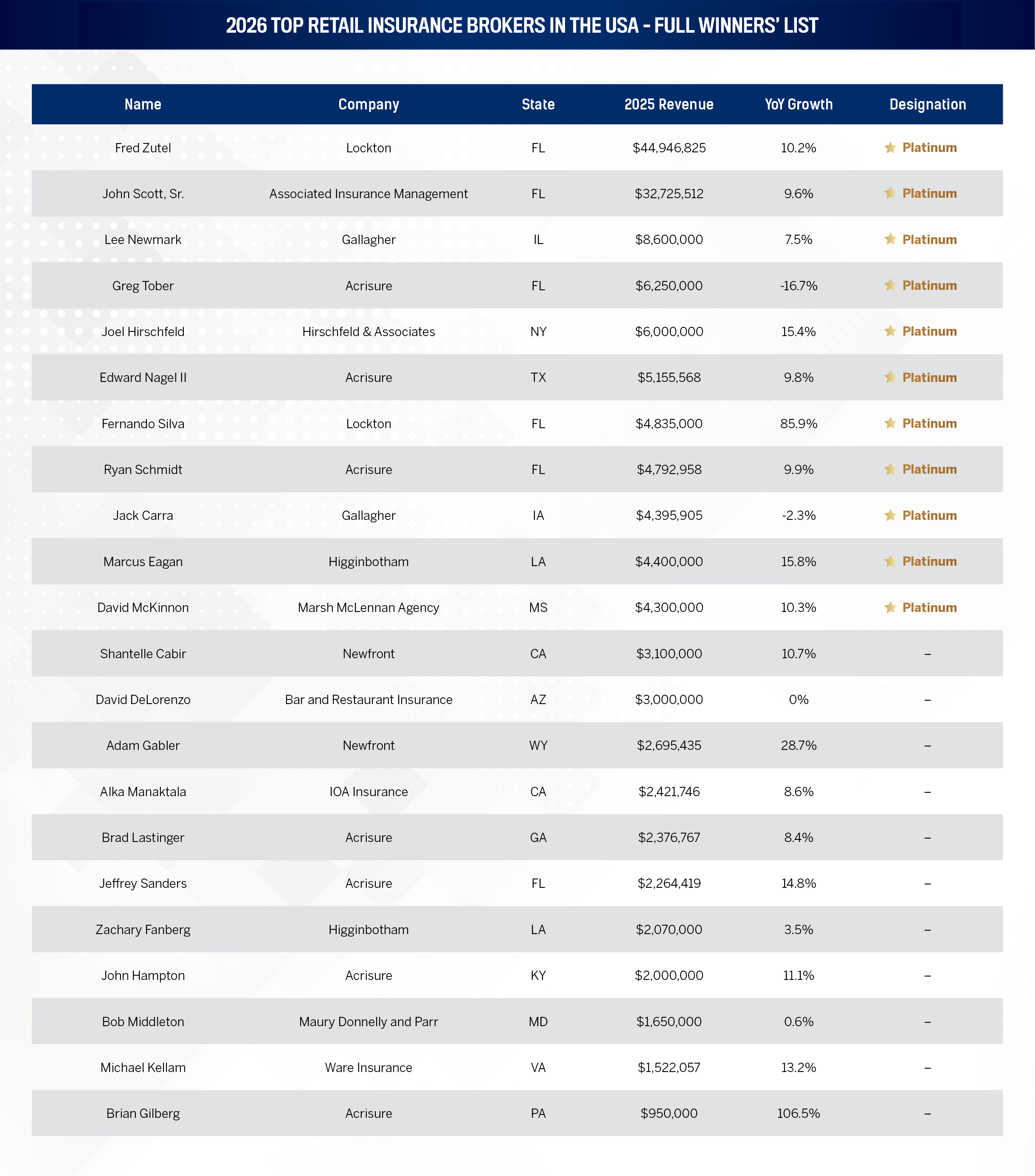
Top Retail Brokers
- Adam Gabler
Principal and Senior Vice President
Newfront - Alka Manaktala
Managing Partner
Insurance Office of America - Bob Middleton
Director of Arts Insurance Program
Maury Donnelly and Parr - Brad Lastinger
Partner/Client Advisor
Acrisure - David McKinnon
Senior Executive Vice President
Marsh McLennan Agency - Edward C. Nagel, II
Energy and Marine Practice Leader
Acrisure - Fernando Silva
Director, Family Office and Transaction Advisory
Lockton - Fred Zutel
President, Property and Casualty
Lockton - Ian Sutherland
Client Advisor and Partner
Acrisure - Jeffrey Sanders
Client Advisor, Partner and Shareholder
Acrisure - Joel Hirschfeld
President
Hirschfeld & Associates - John Hampton
Client Advisor
Acrisure - John Scott, Sr.
President
Associated Insurance Management - Kyle Schielack
Managing Director
Higginbotham - Lee Newmark
Senior Director – Healthcare Practice
Gallagher - Marcus Eagan
Managing Partner
Higginbotham - Michael Kellam
Chief Executive Officer
Ware Insurance - Ryan Schmidt
Manager of Growth – South Division
Acrisure - Shantelle Cabir
Senior Vice President/Business Insurance Broker
Newfront - Zachary Fanberg
Managing Director
Higginbotham
Platinum Retail Brokers
- David McKinnon
Senior Executive Vice President
Marsh McLennan Agency - Edward C. Nagel, II
Energy and Marine Practice Leader
Acrisure - Fernando Silva
Director, Family Office and Transaction Advisory
Lockton - Fred Zutel
President, Property and Casualty
Lockton - Joel Hirschfeld
President
Hirschfeld & Associates - John Hampton
Client Advisor
Acrisure - Lee Newmark
Senior Director – Healthcare Practice
Gallagher - Marcus Eagan
Managing Partner
Higginbotham - Ryan Schmidt
Manager of Growth – South Division
Acrisure