The Real Impact of AI in P&C Claims : Risk & Insurance

Jim Sorrells brings over 35 years of experience in the P&C insurance industry, including 26 years leading claim organizations at a major carrier. As Sales Director for P&C Insurance at DigitalOwl, he is revolutionizing medical records analysis for Bodily Injury, Uninsured Motorist, and Workers’ Compensation claims.
The property & casualty claims industry is reaching a pivotal moment in the adoption of artificial intelligence (AI). What was once viewed as a future-state transformation is now actively reshaping some of the most complex and consequential areas of claims operations, particularly bodily injury evaluation, workers compensation claim management, and claims litigation.
Injury claims have always demanded significant human expertise because they are fundamentally information problems. A single file may contain thousands of pages of medical records, competing provider narratives, prior injuries, evolving treatment plans, attorney demands, and inconsistent documentation spread across multiple systems and formats. Historically, claims professionals have had to manually synthesize this information under tight timelines while simultaneously managing reserves, litigation exposure, negotiation strategy, and customer outcomes.
AI Has Moved from Future Vision to Operational Reality
AI solutions are now rapidly organizing and analyzing large volumes of medical information, producing clear insights, surfacing inconsistencies, identifying potential severity indicators, and accelerating demand evaluation. What once required hours or days of manual review can be completed in minutes with greater accuracy and quality for every claim professional in an organization. AI enables claim professionals and litigation teams to focus more directly on judgment, negotiation, exposure analysis, and resolution strategy. In many organizations, this is beginning to fundamentally alter how claims are evaluated.
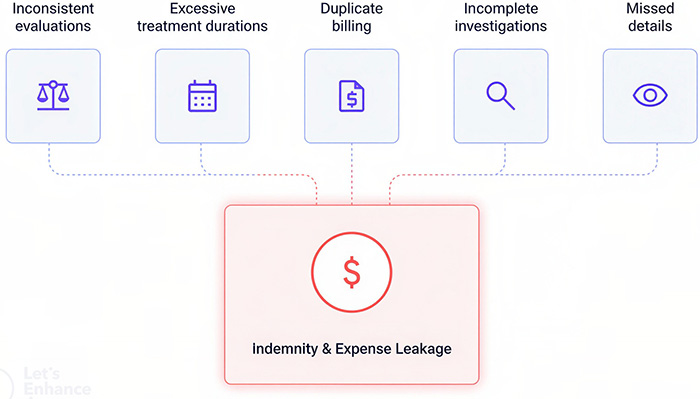
Property & casualty claim organizations face indemnity and expense leakage that often stems from inconsistent evaluations, excessive treatment durations, duplicate billing, incomplete investigations, or missed details buried deep within claim documentation. AI can surface these issues earlier in the claim lifecycle, improving both investigative precision and overall claims consistency, enabling claim organizations to attack and improve ordinary leakage. This is an impactful area where AI Value Realization can be measured.
The Shift from Speed to Better Decision-Making
AI is changing claim management processes, and the strategic value is not simply speed, but clarity in the evaluation and quality of the decision. For claims executives and litigation leaders, this marks a pivotal moment. Rising medical complexity, expanding litigation activity, staffing pressures, and increasing claim severity are forcing organizations to reevaluate how claims professionals spend their time and where expertise delivers the greatest value.
AI is emerging not as a replacement for human judgment, but as a force multiplier. AI-based capabilities are now analyzing structured and unstructured information in injury claims, delivering efficiency and accuracy for claim professionals assigned to evaluate them. What makes this so important is not simply the volume of claims activity. It is the sheer complexity of the decisions involved.
The greatest operational gains are emerging in environments defined by high-severity exposure, large volumes of unstructured information, and increasing decision complexity. Injury claims sit squarely at the center of that challenge. As a result, bodily injury evaluation has become the leading edge of AI transformation across the claims industry. The new AI capabilities will improve early case assessment, reserve confidence, reliable claim insights, defense strategy, and fully informed decision-making.
Where Human Expertise Creates Value
Claims professionals do not want technology that replaces expertise. They want technology that allows expertise to operate more effectively in increasingly complex environments. The carriers that recognize this dynamic, and lead accordingly, will define the next generation of injury claims performance.
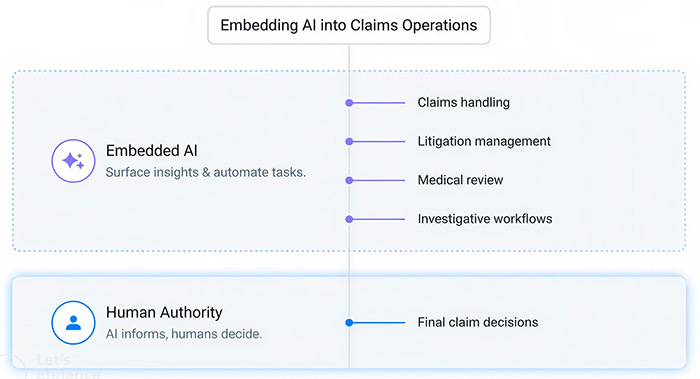
The organizations seeing the strongest results are not approaching AI as a standalone technology initiative. They are embedding it into the operational fabric of claims handling, litigation management, medical review, and investigative workflows while preserving human authority over final claim decisions. That distinction matters.
The Future of Claims Performance Is Decision Intelligence
From medical record review and injury evaluation to reserve setting, litigation management, and claim resolution, the real impact of AI in P&C claims is better decision-making. Organizations that use AI to surface critical insights earlier can reduce uncertainty, improve consistency, and make more informed decisions at every stage of the claim. AI is becoming the infrastructure that enables those decisions at scale. &